Great-Grandpa Goodman
From the grandchildren and great-grandchildren's perspective, he is Great-Grandpa Goodman, a steady civic anchor during the Depression, wartime, and postwar growth.
Focus
5-term Mayor of Mesa (1938-1956)
Founder of Apache Drug (Goodman's Pharmacy)
Broke ground on Falcon Field (1941)
Executive Secretary of Arizona State Fair Commission
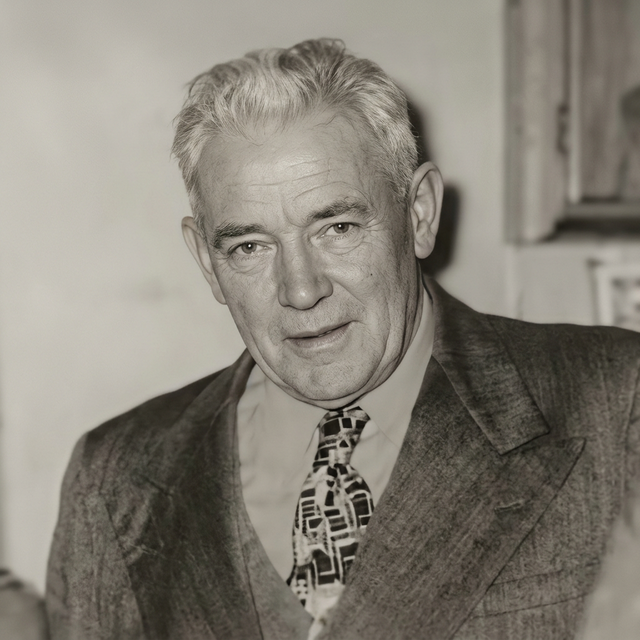
The pharmacy counter
To understand how George Nicholas Goodman became the most durable politician in Mesa's history, start at the drugstore counter. In 1924, he and Clara opened Apache Drug Company (also known as Goodman's Pharmacy) on Main Street, and for the next thirty-five years, that counter was where Mesa happened.
To grasp its function, strip away the modern concept of a sterile, fluorescent-lit chain pharmacy. Apache Drug operated as the civic nerve center and de facto "third place" of a growing agricultural town [S3]S3 — Family NarrativeFamily narrative draft: George Nicholas Goodman (2026-01-18)[PH2]PH2 — DocumentPersonal History 2 (Clifford J. Goodman Jr.).The physical layout of Main Street positioned the pharmacy at the heart of Mesa's commerce. The Sprouse-Reitz five-and-dime store sat three doors east, while the O.S. Stapley hardware and farm equipment store stood a little to the west [PH2]PH2 — DocumentPersonal History 2 (Clifford J. Goodman Jr.). Inside, the pharmacy soda fountain functioned as a bustling family enterprise. During the hot Arizona summers, their youngest daughter, Sherry, worked as a soda jerk, serving cold drinks, including the establishment's signature "Cokes with cream" [S18]S18 — Family NarrativeFamily narrative draft: Clara Platt Goodman (2026-01-18)[S11]S11 — DocumentSherry Lynn Pew Obituary (2021).
During the late 1940s and early 1950s, young Clifford J. Goodman Jr. spent his summers at the store. He would accompany his grandfather to the pharmacy at 4:00 AM. While the adults prepared the prescription counter, Clifford Jr. sat on the floor behind the cigar counter, read five-cent comic books, and mixed milkshakes on the heavy, chrome professional mixers [PH2]PH2 — DocumentPersonal History 2 (Clifford J. Goodman Jr.). Once a week, they arrived at 2:30 AM to let in the floor waxer. The waxer rolled up the long, black, chain-like mat behind the counter to clean the floors. Afterward, George took his grandson to a nearby restaurant for a ham and eggs breakfast [PH2]PH2 — DocumentPersonal History 2 (Clifford J. Goodman Jr.).
Every morning starting around 5:00 AM, local ranchers, farmers, and city leaders (whom Clifford Sr. jokingly called "drugstore cowboys") gathered at the counter to drink coffee. Ranchers discussed cotton prices, crop yields, and Salt River Project water rights. Schoolteachers came in for aspirin and gossip, while city council members met to debate unpaved roads and municipal zoning. George stood behind the counter, cooked breakfast for his guests, listened to their concerns, and used these daily, informal interactions to gauge the needs of the town [S3]S3 — Family NarrativeFamily narrative draft: George Nicholas Goodman (2026-01-18)[PH2]PH2 — DocumentPersonal History 2 (Clifford J. Goodman Jr.).
He was not a dramatic man. Contemporaries described him as a grounded leader who diffused tension with a dry joke and framed complex municipal policy in the plain language of the ranchers he served [S3]S3 — Family NarrativeFamily narrative draft: George Nicholas Goodman (2026-01-18). He managed insulin-dependent diabetes at a time when the condition required constant vigilance, boiling glass syringes, and administering painful injections. Clara's training as a pharmacist enabled her to manage his dosages, directly supporting his demanding public career, though he once missed a city council meeting due to a severe insulin reaction [S18]S18 — Family NarrativeFamily narrative draft: Clara Platt Goodman (2026-01-18)[S3]S3 — Family NarrativeFamily narrative draft: George Nicholas Goodman (2026-01-18). Yet he played softball while serving as mayor, and he kept a palomino horse in a corral behind his house at 528 N. Grand Street, riding it through the increasingly paved streets of Mesa whenever time allowed [S3]S3 — Family NarrativeFamily narrative draft: George Nicholas Goodman (2026-01-18)[PH2]PH2 — DocumentPersonal History 2 (Clifford J. Goodman Jr.).
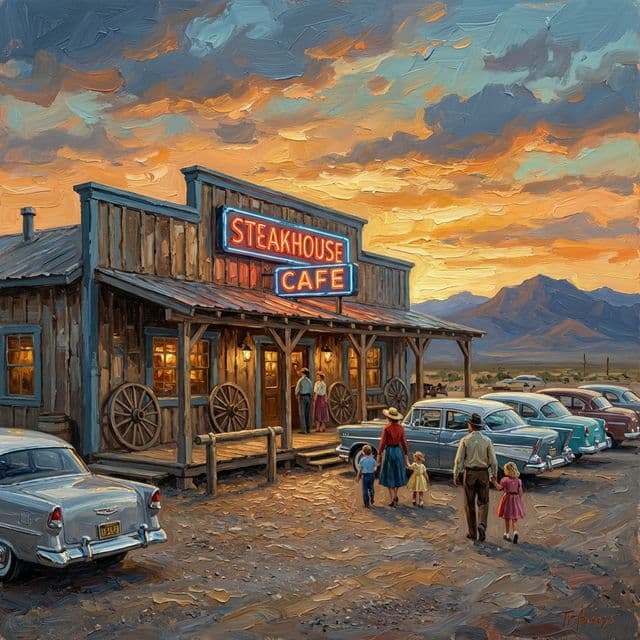
Gila Valley roots and frontier medicine
George was born on September 5, 1895, in St. David, Arizona Territory, the eldest of eight children of George Edward Goodman and Roxsana Othelia Reed Goodman. William Nicholas Goodman, his grandfather, had helped establish the Mormon settlement of St. David [GED]GED — Genealogy DatabaseGEDCOM Master File: William Erastus Platt[WNG]WNG — Genealogy DatabaseGEDCOM Master File: William Nicholas Goodman Life Sketch[StDH]StDH — Archived WebsiteSt. David Heritage Society: Historic Driving Tour, Stop 7 (Archived). In 1906, George's family relocated to Safford in the Gila Valley, where he came of age in a region defined by its rugged agricultural landscape and frontier conditions [GOF]GOF — DocumentGenerations of Faith (family history book)[S3]S3 — Family NarrativeFamily narrative draft: George Nicholas Goodman (2026-01-18).
The Gila Valley's medical care centered on Clara's father, Dr. William Erastus Platt. Dr. Platt operated a network of three pharmacies in Safford, Thatcher, and Pima, which served as the primary medical hubs for the entire valley [S40]S40 — Journal ArticleAudrey D. Stevens, 'Dr. William Erastus Platt: Healer of the West,' Arizona Medicine, January 1969. In an era without a formal hospital, Dr. Platt used these drugstores to store chemical inventory and compound medicines. He also performed emergency appendectomies and other surgeries on his patients' dining room tables using standard kitchen utensils [S40]S40 — Journal ArticleAudrey D. Stevens, 'Dr. William Erastus Platt: Healer of the West,' Arizona Medicine, January 1969. His home in Safford was regularly converted into a clinic or a temporary mortuary, with family members sharing beds to accommodate recovering patients [S40]S40 — Journal ArticleAudrey D. Stevens, 'Dr. William Erastus Platt: Healer of the West,' Arizona Medicine, January 1969. In 1918, shortly after his first wife, Isobel, passed away, Dr. Platt and Dr. T. H. Slaughter organized a mass tonsillectomy clinic at the Platt home. Over two days, they performed more than 200 operations on the family dining room table, assisted by Dr. Platt's three eldest daughters [S40]S40 — Journal ArticleAudrey D. Stevens, 'Dr. William Erastus Platt: Healer of the West,' Arizona Medicine, January 1969[S46]S46 — News ArticleIsabelle Hill Romney Platt Obituary, Graham Guardian (Safford), June 13, 1919.
It was in these drugstores that George and Clara's partnership began. George found employment as a teenager in Dr. Platt's pharmacies in Pima, Thatcher, and Safford, learning the compounding trade under his future father-in-law's supervision [S3]S3 — Family NarrativeFamily narrative draft: George Nicholas Goodman (2026-01-18). Clara, who grew up watching her father mix tinctures and powders, met George in the drugstores, and their professional association evolved into a courtship [S18]S18 — Family NarrativeFamily narrative draft: Clara Platt Goodman (2026-01-18).
They married in Safford on June 30, 1916 [GED]GED — Genealogy DatabaseGEDCOM Master File: William Erastus Platt. Seeking formal training, they moved to Los Angeles, California, to attend pharmacy school together. After completing the two-year program and graduating as licensed pharmacists, they returned to the Gila Valley, residing in Thatcher in 1920 [S18]S18 — Family NarrativeFamily narrative draft: Clara Platt Goodman (2026-01-18)[S3]S3 — Family NarrativeFamily narrative draft: George Nicholas Goodman (2026-01-18). Eager to establish their own independence away from Dr. Platt's immediate professional shadow, they relocated to the Salt River Valley in 1924, opening Apache Drug in downtown Mesa with Dr. Platt retaining a financial interest in the new venture [GOF]GOF — DocumentGenerations of Faith (family history book)[S3]S3 — Family NarrativeFamily narrative draft: George Nicholas Goodman (2026-01-18)[S40]S40 — Journal ArticleAudrey D. Stevens, 'Dr. William Erastus Platt: Healer of the West,' Arizona Medicine, January 1969.
A legacy of compounding: the creolin throat swab
The medical and compounding legacy of the family includes a famous, highly memorable throat swab remedy used to treat sore throats and respiratory infections. The mixture consisted of 1 part creolin, a coal-tar disinfectant and antiseptic, to 10 parts glycerin [GED]GED — Genealogy DatabaseGEDCOM Master File: William Erastus Platt[S40]S40 — Journal ArticleAudrey D. Stevens, 'Dr. William Erastus Platt: Healer of the West,' Arizona Medicine, January 1969.
While family oral history sometimes conflated the origin of this remedy, attributing it to George's grandfather William Nicholas Goodman, primary genealogical records clarify its true source. The master family database sketch explicitly attributes the formula to Dr. William Erastus Platt [GED]GED — Genealogy DatabaseGEDCOM Master File: William Erastus Platt. William Nicholas Goodman was an English carpenter who worked on LDS temples and died in St. David in 1885; he did not practice medicine or pharmacy in the Gila Valley [WNG]WNG — Genealogy DatabaseGEDCOM Master File: William Nicholas Goodman Life Sketch. The similar first names of Dr. William Erastus Platt and William Nicholas Goodman likely caused the subsequent oral history conflation. The compounding of this memorable throat swab remedy belongs to Dr. Platt's pioneering medical practice in Safford [GED]GED — Genealogy DatabaseGEDCOM Master File: William Erastus Platt[S40]S40 — Journal ArticleAudrey D. Stevens, 'Dr. William Erastus Platt: Healer of the West,' Arizona Medicine, January 1969.
| Year | Event |
|---|---|
| 1895 | Born in St. David, Arizona Territory |
| 1906 | Family moves to Safford |
| 1916 | Marries Clara Platt; attends pharmacy school in Los Angeles |
| 1924 | Returns to Mesa; opens Apache Drug |
| 1936 | Elected to Mesa City Council |
| 1938–1956 | Serves five terms as Mayor of Mesa |
| 1941 | Breaks ground on Falcon Field with Governor Osborn |
| 1947 | President of Arizona Pharmaceutical Association |
| 1952 | Welcomes Chicago Cubs spring training to Mesa |
| 1955 | Named Mesa's Most Valuable Citizen |
| 1956 | Appointed Executive Secretary, Arizona State Fair Commission |
| 1959 | Dies in Mesa at age 64 |
The five-term mayor
During George's era, Mesa citizens elected the city council, and the council chose the mayor from its own ranks. That meant his five terms, across three separate decades, required the sustained confidence of his peers, not just a one-time campaign win.
[S1]S1 — Archived WebsiteWikipedia: George Nicholas Goodman (Archived)| Years | Role | Notes |
|---|---|---|
| 1936–1948 | City Council | 12 years continuous service. |
| 1938–1942 | Mayor | Two terms during Depression and war. |
| 1946–1948 | Mayor | Post-war return: housing boom, utility expansion. |
| 1952–1956 | Mayor | Final terms; Cubs arrive; lost reelection by one vote. |
The war years and Falcon Field
In July 1941, five months before Pearl Harbor, Mayor Goodman stood alongside Governor Sidney P. Osborn at 10:30 a.m. and dug the first shovels of dirt for both Falcon Field and Williams Field on the very same day. Falcon Field opened on September 14, 1941 as the No. 4 British Flying Training School, established under the Lend-Lease Act. It was too dangerous to train RAF cadets in England with the Luftwaffe overhead, so the Arizona desert stood in.
Over four years, Falcon Field trained more than 2,300 British cadets alongside American pilots, flying Boeing Stearman biplanes and AT-6 Texans across Mesa's cotton fields. Twenty-three British cadets, one American cadet, and four instructors died during training. They are buried in the Mesa City Cemetery.
[S12]S12 — Archived WebsiteWikipedia: City of Mesa Cemetery (Archived) [S2]S2 — Archived WebsiteWikipedia: Falcon Field (Arizona) (Archived)That January, he had joined the federal wartime rationing board for Maricopa County, making hard decisions about which neighbors received tires and sugar. By April 1942, he was in Washington, D.C., walking the halls of Congress to lobby for construction materials, securing federal concrete and steel for a desert town that was still, in many ways, an unpaved farming village bursting at the seams from the wartime influx.
[S1]S1 — Archived WebsiteWikipedia: George Nicholas Goodman (Archived)The Cubs, the streetlights, and the one-vote loss
George was a lifelong Chicago Cubs fan. In 1952, under his mayoralty, the Cubs began holding spring training in Mesa. It was more than a sports story: a tourism coup that linked the name "Mesa" to a national franchise and brought Midwestern visitors every March. The partnership endures over seventy years later.
[S1]S1 — Archived WebsiteWikipedia: George Nicholas Goodman (Archived)In 1953, he flipped the switch on a new downtown streetlight system that replaced the original 1922 installation. The new lights delivered twice the illumination at half the energy cost, with a 6,000-hour guarantee. It was the kind of unglamorous civic work that defined his tenure: practical, measurable, permanent.
[S1]S1 — Archived WebsiteWikipedia: George Nicholas Goodman (Archived)His political career ended in 1956 with a recount loss by exactly one vote. The council presented him with a gold wristwatch, a token of "admiration and respect" from the peers who had chosen him five times.
[S1]S1 — Archived WebsiteWikipedia: George Nicholas Goodman (Archived)Statewide reach
George led the Arizona Pharmaceutical Association in 1947–1948, pushed for a five-year pharmacy program at the University of Arizona, served as president of the Arizona Municipal League in 1954, and chaired the local Red Cross chapter. In 1958 the League named him a Life Member, its highest honor.
[S1]S1 — Archived WebsiteWikipedia: George Nicholas Goodman (Archived)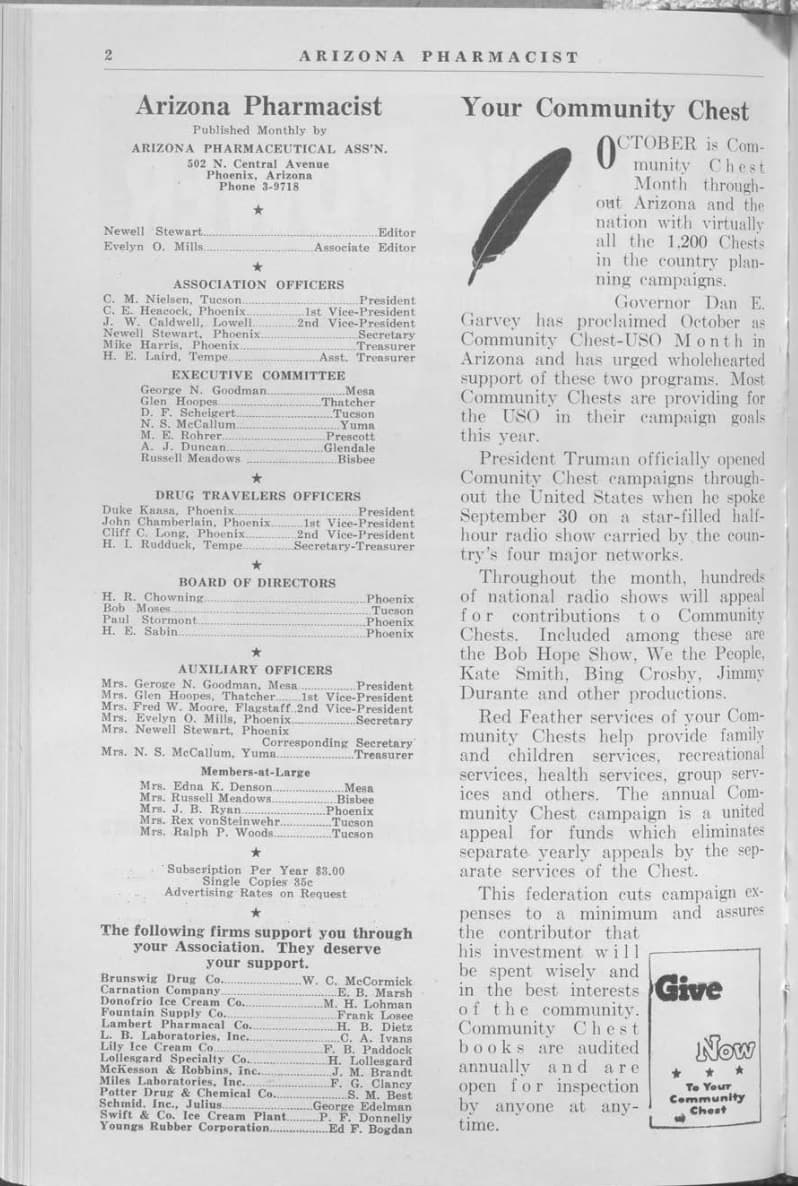
Death and the bomber flyover
In 1956, he was appointed executive secretary of the Arizona State Fair Commission, the organization's top administrative role. The two previous holders had resigned in quick succession and had been paid $1,800 more annually; George accepted the job at $8,400 a year.
[S1]S1 — Archived WebsiteWikipedia: George Nicholas Goodman (Archived)He died unexpectedly on November 3, 1959, at his home in Mesa, still serving in that post. He was sixty-four. At his funeral two days later, a squadron of bombers flew over the fairgrounds in Phoenix while a Marine color guard paid respects at the services in Mesa, a last salute from the pilots whose bases he had helped bring to the Valley.
[S1]S1 — Archived WebsiteWikipedia: George Nicholas Goodman (Archived)He is buried in the City of Mesa Cemetery. Clara died on February 8, 1984, in Mesa at age eighty-five and was buried alongside George.
[GED]GED — Genealogy DatabaseGEDCOM Master File: William Erastus PlattRecognition
- 1955: Named Mesa's Most Valuable Citizen of the Year
- 1955: Rotarian Citizenship Award
- 1958: Life Member, League of Arizona Cities and Towns
- 1988: Chandler Unified School District names Clifford J. Goodman Elementary in honor of his son
- 2019: Arizona Pharmacy Association Hall of Fame (posthumous)
Stories Featuring Great-Grandpa Goodman
Sources
- [S3]↑Family narrative draft: George Nicholas Goodman (2026-01-18)Family Narrative
- [PH2]↑
- [S18]↑Family narrative draft: Clara Platt Goodman (2026-01-18)Family Narrative
- [S11]↑Sherry Lynn Pew Obituary (2021)Document
- [GED]↑GEDCOM Master File: William Erastus PlattGenealogy Database
- [WNG]↑GEDCOM Master File: William Nicholas Goodman Life SketchGenealogy Database
- [StDH]↑
- [GOF]↑
- [S40]↑
- [S46]↑
- [S1]↑Wikipedia: George Nicholas Goodman (Archived)Archived Website
- [S12]↑Wikipedia: City of Mesa Cemetery (Archived)Archived Website
- [S2]↑Wikipedia: Falcon Field (Arizona) (Archived)Archived Website
Comments
Loading comments...