Leona Dana
Daughter of Lafayette Dana and Adeline Riggs. Wife of Earl Ellsworth. Mother of Earlene Ellsworth Goodman.
Focus
Mother of Earlene Ellsworth Goodman
Wife of pioneer farmer Earl Ellsworth
Daughter of Lafayette Dana and Adeline Riggs
Mother of seven children
Leona Dana
(registered in official records as Leoma Ellen Dana) was born on April 26, 1904, at Alma, Arizona Territory. She was the daughter of Lafayette Dana (1876-1912) and Adaline Amerilla Riggs (1879-1951). Her father, Lafayette Dana, was born in Montpelier, Idaho, and died at age 36 in Mesa, Arizona. Her mother, Adaline Amerilla Riggs, was born in Springerville, Arizona, and died in Mesa. Adaline was the daughter of Charles Hamblin Littlefield Riggs and Nancy Marie Babbitt. The Dana family, like the Ellsworths, were part of the network of LDS pioneer families who settled the Salt River Valley and the broader Arizona Territory in the late nineteenth century.The Dana Family and Pioneer Marriage
[GED]GED — Genealogy DatabaseGEDCOM Master File: William Erastus PlattLafayette Dana died in 1912, the same year Arizona achieved statehood. Leona was eight years old. The cause of death is unrecorded in surviving genealogical records, but at thirty-six he was young even by the standards of early Arizona, where tuberculosis, farming accidents, and common infections killed men in their prime. His death left Adaline a widow at thirty-three with young children in a territory that had barely become a state, with no Social Security, no welfare infrastructure, and no reliable life insurance system in rural communities.
[GED]GED — Genealogy DatabaseGEDCOM Master File: William Erastus PlattWhat it meant to lose a father at eight in 1912 Arizona is difficult to reconstruct at this distance, but the economic consequences were concrete. A widow with children depended on extended family, on the LDS ward's informal charity networks, and on whatever labor she could perform herself. Adaline raised Leona through the 1910s as a single mother in a state so new it had barely printed its own letterhead. Leona grew up understanding, before she had words for it, that women managed alone when circumstances demanded it.
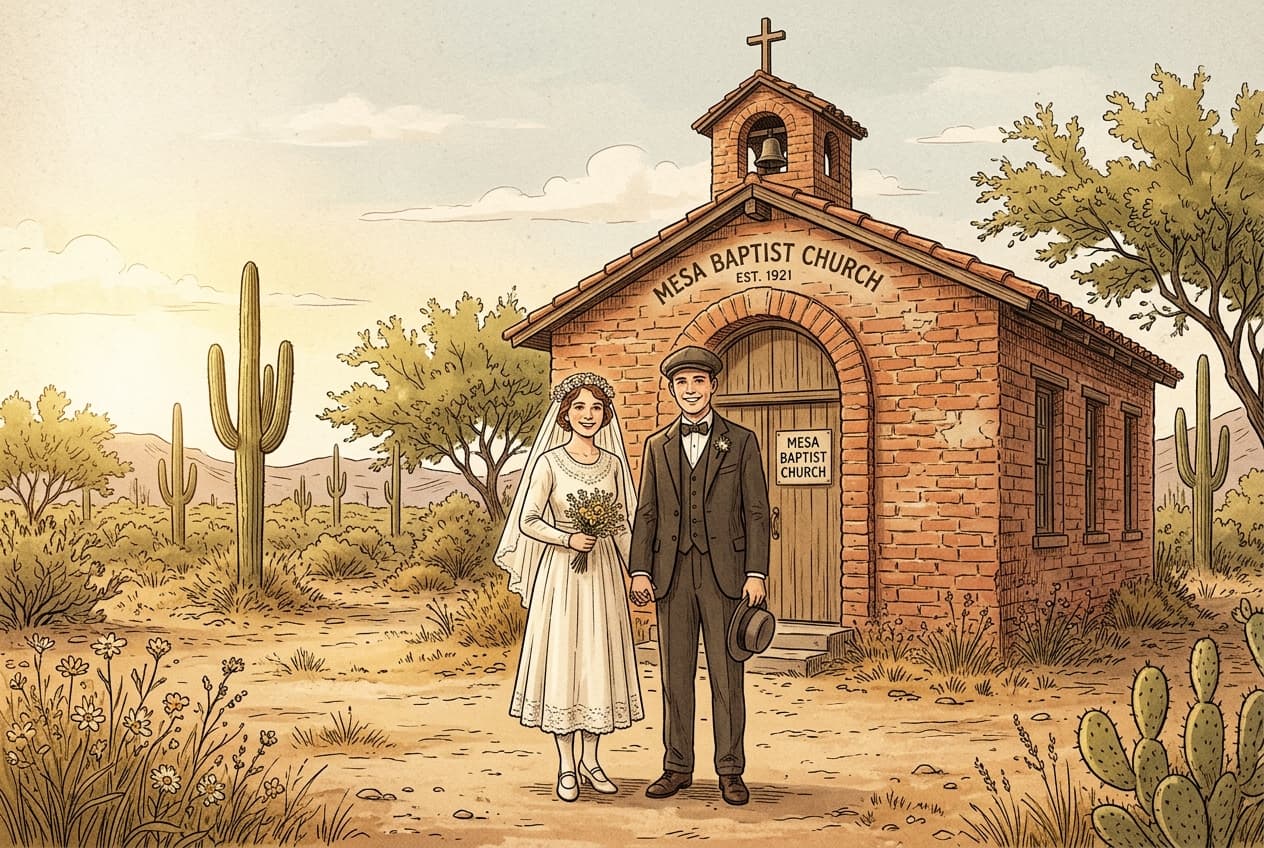
[Ellsworth-Book]Ellsworth-Book — UnknownSource: Ellsworth-BookOn July 14, 1922, Leona married Earl Ellsworth, the seventh child of Louis Ellsworth and Josephine Lauvina Crismon. She was eighteen; he was nineteen. While the family history book Our Ellsworth Ancestors mistakenly listed her birth year as 1908, making her appear to be a fourteen-year-old bride, verified census and state records confirm her 1904 birth. This birth date error likely arose from a conflation with Earl's twin sister, Leona Ellsworth, who was born on July 27, 1908. The compiler mixed up the two women named Leona. Her actual age at marriage was eighteen years and two months, resolving the family myth of a child marriage. The marriage united two pioneer families, and together they navigated the agricultural calendar of the valley.
Raising Seven Children Through the Depression
Together they settled in the East Valley, where Earl continued the agricultural work his father had pioneered. They raised seven children: Earlene, Adeline Josephine, Virginia, Paula Dean, Dana Earle, Vicki, and Linda.
[Ellsworth-Book]Ellsworth-Book — UnknownSource: Ellsworth-BookThe 1920s in the Salt River Valley were a period of cautious optimism. The completion of Roosevelt Dam in 1911 had tamed the Salt River and made large-scale irrigated farming possible, transforming the desert floor into a patchwork of cotton fields, citrus groves, and alfalfa pastures. The canal system, maintained by the Salt River Project, delivered water to farms on a rotating schedule, and the rhythm of irrigation defined daily life for families like the Ellsworths: when the water came, everything else stopped.
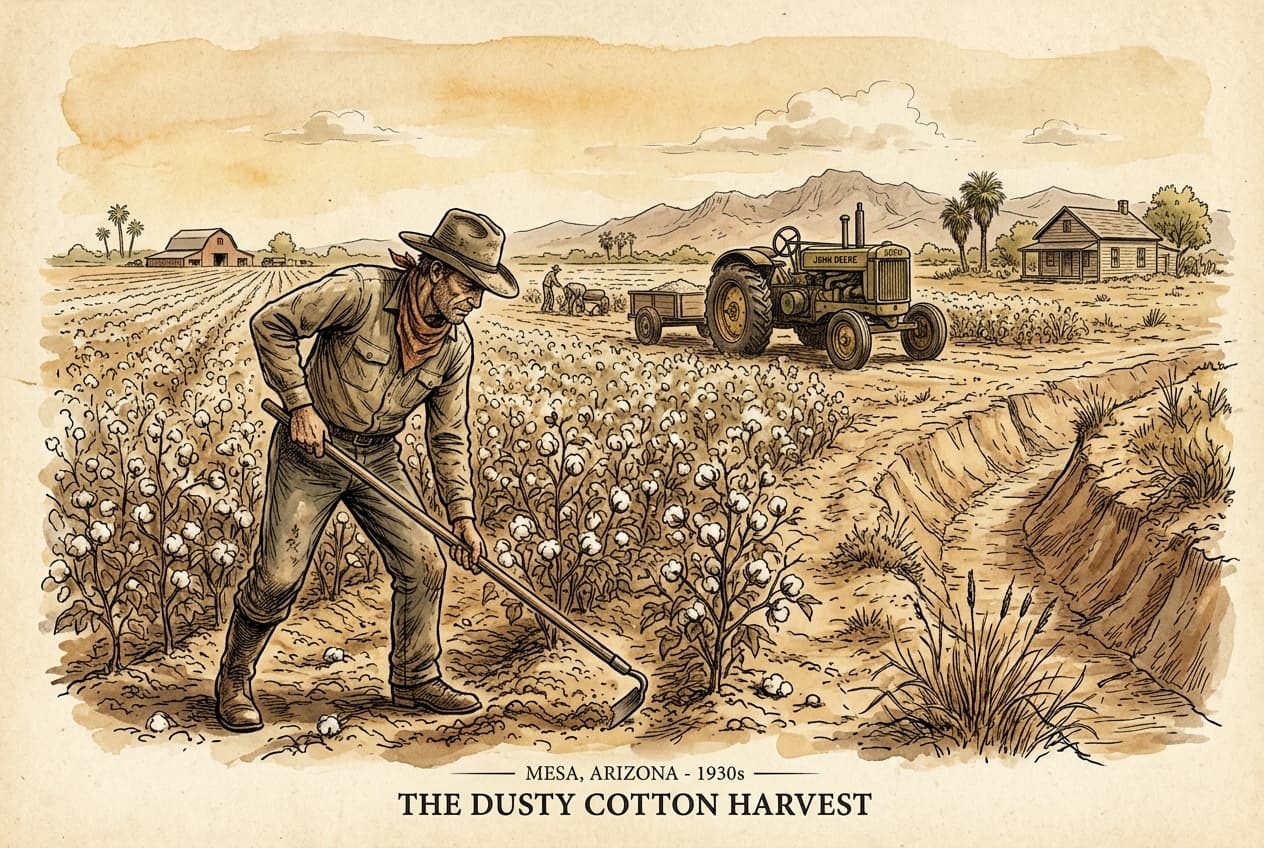
The Depression hit Arizona's agricultural economy hard. Cotton prices, which had been the lifeblood of the East Valley, collapsed from 35 cents a pound to under six cents. Families lost farms to foreclosure. The Ellsworths survived, but raising seven children through the worst economic crisis in American history required the kind of resourcefulness that leaves no written record: canning food, patching clothes, stretching every dollar across a household where mouths outnumbered paychecks.
Depression-Era Survival
The crash of 1929 turned cautious optimism into sustained crisis across the Salt River Valley. Earl had already pivoted from his family's ostrich operation to cotton and other crops, following the same path his brother Louis Byron and dozens of other East Valley farmers had taken after the feather market collapsed during the First World War. When cotton prices fell from thirty-five cents a pound to under six cents, that pivot looked less like foresight and more like trading one vulnerability for another.
For Leona, the Depression was measured in domestic labor. Seven children required three meals a day, and those meals came largely from the household itself. She canned fruit and vegetables through the brutal Mesa summers, working over boiling pots in kitchens where the temperature climbed past 110 degrees because the food would not preserve itself and the family could not afford to buy what it could grow. She sewed and resewed clothes, patching garments that had already been patched. She managed the household accounts with the precision of someone who understood, from growing up in a widow's home, exactly how thin the margin between surviving and losing everything could be.
The Salt River Project's irrigation schedule structured the entire rhythm of farm life. Water arrived on a rotation, often in the middle of the night, and when it came, everything else stopped. Earl worked the fields and managed the canals. Leona managed everything inside the house and most of what happened between the house and the fields: the kitchen garden, the poultry, the preservation of food that would carry the family through lean months. The division of labor was absolute and unquestioned. It was also relentless.
Neighbors lost their land. Foreclosure auctions became a regular feature of East Valley life through the early 1930s. The Ellsworths held on. How exactly they managed it is unrecorded, but families who survived the Depression in agricultural Arizona shared certain traits: they diversified crops rather than gambling on a single commodity, they produced most of their own food, and they leaned on the LDS ward's mutual aid networks, which functioned as an informal welfare system years before the federal government built its own.
The War Years and Beyond
By 1940, the worst of the Depression had passed, and a different kind of upheaval arrived. In that year, Leona's eldest daughter Earlene married Dr. Clifford James Goodman Sr. in Florence, Arizona. The young couple soon moved to Washington, D.C., where Clifford completed his medical training at George Washington University School of Medicine. Their first child was born in the capital in 1943, the same year the Pentagon was completed across the Potomac.
For Leona, watching her eldest daughter leave for the East Coast would have carried a particular weight. Earlene was eighteen, the same age Leona herself had been when she married. The world Earlene entered, wartime Washington, crowded with military personnel and government workers, bore no resemblance to the cotton fields and irrigation canals of Mesa. The distance between mother and daughter was geographic but also generational: Leona had married at eighteen into the same agricultural community where she was born. Her daughter married a physician and moved two thousand miles away.
The home front in Mesa during the 1940s looked different from the Depression years. The military training bases at Williams Field and Falcon Field, both east of town, brought an influx of personnel and federal money that jumpstarted the local economy. Farmers grew long-staple cotton for military parachutes and uniforms. Leona's younger children came of age in a valley that was beginning to shed its frontier character and take on the shape of the suburban corridor it would become after the war. She watched some of her children leave, as all farm mothers did during the war years, and she waited for them to come back.
A Lasting Legacy
Through Earlene's marriage to Dr. Goodman, Leona became the grandmother of the Goodman medical dynasty. The union bonded the Ellsworth agricultural line to the Goodman medical legacy for generations. The name "Dana" persisted through the children's names: her son was named Dana Earle, reversing his parents' names, a common practice in LDS families where naming children after both sides served as a living genealogical record.
[Ellsworth-Book]Ellsworth-Book — UnknownSource: Ellsworth-BookLeona lived long enough to see her granddaughter Earlene widowed in 1962, when Dr. Goodman died unexpectedly at forty. She watched her daughter take on the same burden that Adaline had carried half a century earlier: raising children alone, managing a household without a husband, finding a way forward through sheer persistence. The symmetry was stark. Adaline lost Lafayette at thirty-three in 1912. Earlene lost Clifford at thirty-nine in 1962. Fifty years apart, two women in the same line faced the same fracture.
Whether Leona recognized the echo is unknowable. She had grown up in a widow's household and understood what came next: the immediate financial crisis, the reorganization of daily life around absence, the quiet expectation that women would simply endure. She had watched Adaline do it. Now she watched Earlene do it. The resilience that Adaline modeled in territorial Arizona passed through Leona to Earlene, a maternal inheritance more durable than any deed or bank account.
[GED]GED — Genealogy DatabaseGEDCOM Master File: William Erastus Platt| Year | Event |
|---|---|
| 1904 | Born April 26 in Alma, Arizona Territory, to Lafayette Dana and Adaline Amerilla Riggs |
| 1910 | Resides in Maricopa County, Arizona (US Census) |
| 1920 | Resides in Mesa, Arizona |
| 1922 | Marries Earl Ellsworth on July 14 in Mesa, Arizona, at age 18 |
| 1930 | Resides in Lehi, Maricopa County, Arizona |
| 1935 | Resides in Mesa City, Graham County, Arizona |
| 1940 | Resides in Supervisorial District 3, Navajo County, Arizona |
| 1993 | Dies October 5 in Chandler, Arizona, at age 89; buried October 8 in Mesa, Arizona |
Sources
- [GED]↑GEDCOM Master File: William Erastus PlattGenealogy Database
Comments
Loading comments...